Customer support in India is undergoing a major shift, leaders are looking for AI Search for their service desk teams. For years, enterprises rushed to automate customer service by deploying front-facing chatbots. But the strategy backfired: endless looping bots, rigid decision trees, and unhelpful automatic responses left consumers frustrated.
When complex queries hit a wall, customers don’t want a bot, they want a human agent who can solve their problem quickly.
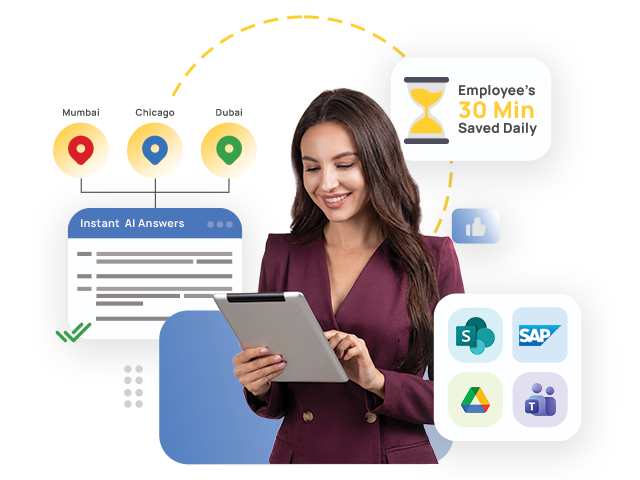
The real breakthrough in AI for service desks isn’t replacing human agents; it’s empowering them. By shifting AI from customer-facing bots to agent-facing AI Search, service desk teams in India can locate exact SOPs, technical troubleshooting steps, and policy updates in seconds.
Automated AI Support Desk vs Human Agent
Most consumer-facing AI chatbots operate on rigid, intent-matching scripts. When a customer presents a unique or nuanced issue, these bots tend to repeat the same stock answers, leading to infinite loops and rising frustration in customers.
When customers hit a roadblock, their immediate reaction is to bypass the bot and demand a human representative. However, transferring a frustrated customer to a human agent creates a new bottleneck if that agent takes minutes to search through disconnected document repositories.
The winning approach isn’t choosing between an AI bot and a human agent. It is using AI Search internally to give human agents instant access to knowledge, combining human empathy with machine efficiency.
Where Do Service Desk Teams in India Struggle?
Service desks across India from telecom giants and fintech startups to IT services exporters face distinct operational hurdles:
- Massive Product & Policy Complexity: Agents must navigate hundreds of changing plans, regional compliance rules, and technical SOPs across multiple lines of business.
- Information Fragmentation: Critical knowledge sits scattered across PDF manuals, SharePoint, Google Drive, internal wikis, and historical ticketing systems like Jira or ServiceNow.
- High Attrition & Long Onboarding Cycles: Call centers and IT helpdesks experience high agent turnover. Training new agents on complex knowledge bases often takes 4 to 8 weeks.
- Multilingual & Contextual Gaps: Indian service desks routinely handle customer queries across multiple languages and dialects, making standard keyword search ineffective for finding contextual answers.
What Do Service Desk Teams in India Need to Simplify Their Lives?
To deliver fast, accurate support without burnout, Indian service desk agents need tools designed for modern knowledge workflows:
- Unified Contextual Search: A single search bar that queries across all company repositories like SOPs, ticket histories, PDF guides, and video transcripts using natural language understanding rather than exact keyword matches.
- Instant Direct Answers (Not Document Links): Agents don’t have time to open a 50-page PDF and scroll to page 32 during a live call. They need precise, synthesized answer snippets.
- Real-Time Knowledge Updates: When policies or troubleshooting steps change, updates must be indexed instantly so agents never relay outdated information.
- Zero-Friction System Integration: AI search tools must plug directly into existing platforms like Zendesk, Salesforce, Freshdesk, or Microsoft Teams where agents already work.
How AI Search Helps Human Agents Improve CSAT
When human agents have instant access to an enterprise AI Search engine, support metrics improve across the board:
- Drastic Reduction in Average Handle Time (AHT): Instead of keeping callers on hold for 3–5 minutes while hunting through manuals, agents find verified answers in under two seconds.
- Higher First-Contact Resolution (FCR): Agents can resolve complex, edge-case queries on the first interaction without escalating to Tier-2 support teams.
- Lower Agent Stress & Cognitive Fatigue: Agents focus on listening to the customer and exercising empathy, rather than stressing over search queries across fragmented systems.
- Consistent Quality Across Tier-1 and Tier-2: Junior agents deliver the expertise of seasoned veterans from day one, raising overall Service Level Agreement (SLA) compliance and Customer Satisfaction (CSAT) scores.
Here is a more detailed article on Super Charging your NPS & CSAT with AI Powered Knowledge Management
Which Other Metrics Should You Look at When Evaluating AI Search?
While CSAT is the ultimate destination, evaluating an internal AI Search solution requires tracking specific operational indicators:
| Metric | Why It Matters |
| Search-to-Resolution Time | Measures how fast an agent goes from entering a query to resolving the customer issue. |
| Escalation Rate | Tracks the percentage of Tier-1 tickets passed to Tier-2 or engineering teams due to lack of information. |
| Time-to-Productivity (TTP) | Measures how many days or weeks it takes a newly hired agent to hit standard performance targets. |
| Knowledge Base Usage & Gap Identification | Highlights which search queries return zero results, revealing missing SOPs or outdated documentation. |
How Tools Like BHyve AI Help Service Desk Teams
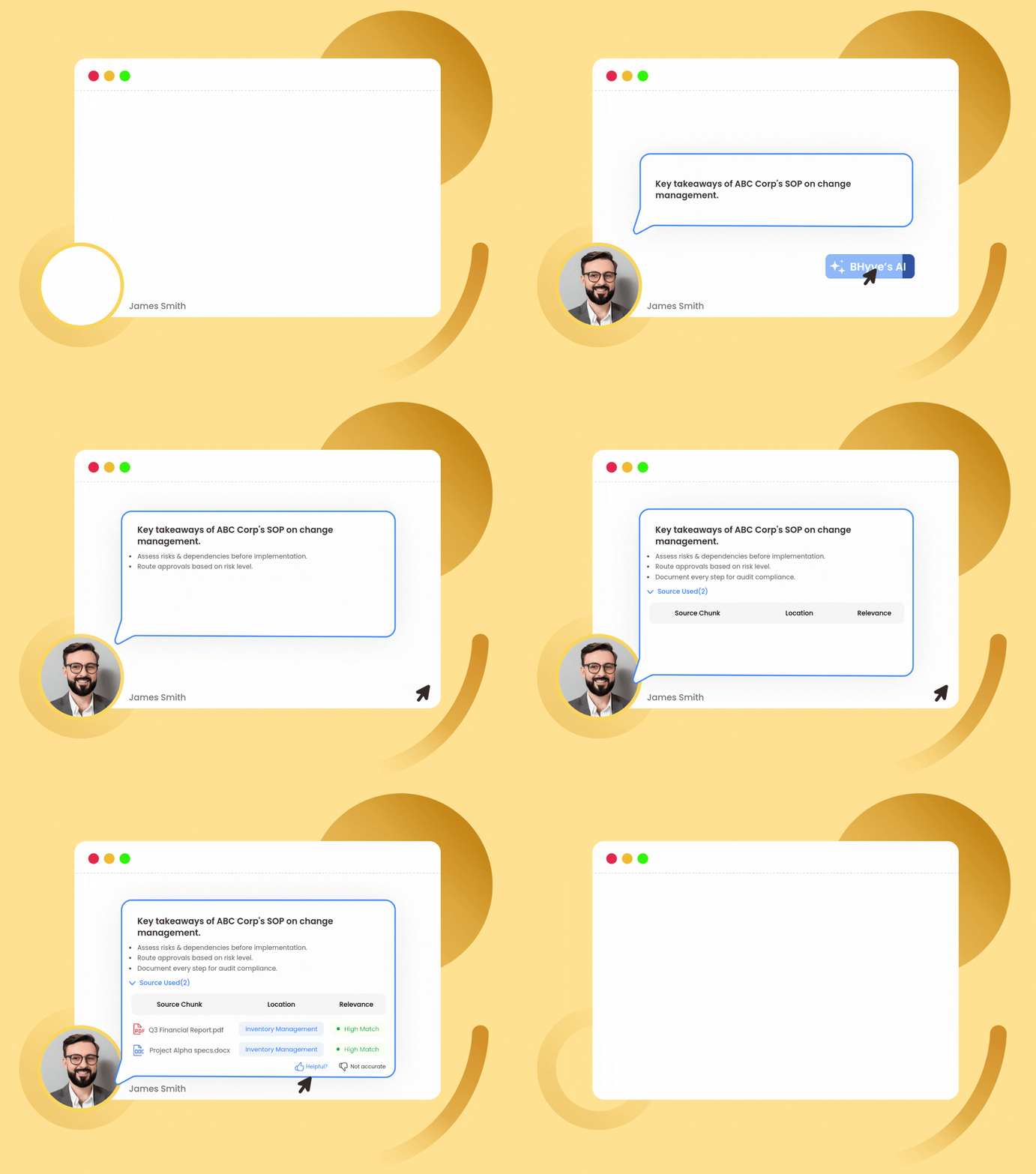
BHyve AI is an AI-powered knowledge platform built specifically to eliminate information silos within enterprise teams. Rather than forcing agents to search across disconnected drives, BHyve centralizes tacit and explicit organizational knowledge into an intelligent engine.
- Generative Summarization: BHyve extracts concise summaries from lengthy manuals, SOPs, and video tutorials so agents get actionable steps immediately.
- Direct AI answers in specific templates: BHyve AI can get agents quick answers from the documents in a template that is suitable for them.
- Rapid Deployment & Low Training: Designed for quick implementation, BHyve integrates into existing agent workflows with minimal onboarding friction.
Why Tata Play Fiber Recently Deployed BHyve AI for the Service Desk Team
As one of India’s leading entertainment and broadband providers, Tata Play Fiber manages large-scale support operations. Delivering high-quality customer experience across direct-to-home (DTH) and broadband services requires frontline teams to resolve complex technical and account-related queries swiftly.
To address fragmented internal knowledge and streamline support, Tata Play Fiber integrated BHyve AI into its service desk ecosystem. By indexing complex SOPs, technical manuals, and operational reports into BHyve’s enterprise search layer, Tata Play Fiber enabled its teams to:
- Locate Exact SOP Steps Instantly: Agents retrieve precise resolution paths across documents and video guides without manual searching.
- Accelerate Onboarding: Newly joined support members leverage the living knowledge hub to resolve queries faster with less reliance on senior team managers.
- Drive Consistent Quality: Standardized information delivery across support tiers ensures customers receive accurate answers regardless of who takes the call.
Other AI Search Tools for Service Desk Teams
While BHyve provides a specialized knowledge platform, several other enterprise tools offer AI-driven search capabilities for service desks:
- Koveo (Coveo for Service): An enterprise-grade AI search and recommendation engine designed for complex, multi-tiered contact centers integrated with Salesforce or ServiceNow.
- Elastic Enterprise Search: A developer-focused platform that allows engineering teams to build custom semantic search tools over internal ticket databases and help centers.
The Future of Customer Service Is Human + AI Search
The future of customer support in India isn’t automated bots operating in isolation. The winning formula is Human + AI Search, combining human judgment, empathy, and regional communication skills with the speed and accuracy of generative search tools.
By equipping service desk agents with internal AI search platforms like BHyve, enterprises can eliminate agent burnout, slash handle times, and deliver the quick, accurate resolutions Indian consumers expect.
Ready to empower your service desk agents with instant enterprise knowledge?