In 2026, Enterprise Knowledge Management is no longer a dusty digital filing cabinet with complex workflows that confuse users. It is an interactive, intelligent system that learns as your business grows. Modern EKM systems connect the dots between your shop floor and your boardroom, turning static SOPs into interactive assistants. Today, it's AI Knowledge Management - An AI system that understands and tailors your knowledge as per your needs. Let’s dive into what that means your IT strategy in 2026
What is Enterprise Knowledge Management?
Enterprise Knowledge Management (EKM) is a systematic approach for any organisation to capture, organise, share, and apply the knowledge of the business into everyday work. Think of old school filing systems, built to help employees find information faster. As digitalisation of our workplaces happened, the number of files grew, and soft copies were scattered in too many places. Different locations maintain different versions of an SOP, and teams work with outdated regulations or designs. An Enterprise Knowledge Management System brings in all the knowledge of your business - explicit knowledge of SOPs, checklists, audit reports, designs, sales material, and implicit knowledge of best practices, insights, and learnings together. Employees get one portal, one software where they can find anything quickly and reliably.
An Enterprise Knowledge Management Software should primarily support key processes
Capture: Gathering data from sources like employee expertise, docs, and databases.
Organization: Structuring info with taxonomies, metadata, and searchable repositories.
Sharing and Transfer: Distributing knowledge via tools like intranets, knowledge bases, and collaboration platforms.
Application and Maintenance: Using insights for decisions and regularly updating content for accuracy.
A robust system builds a single source of truth for your entire organisation.
Why Enterprise Knowledge Management Is a Business-Critical Priority in 2026
The broad impact of a lack of a sophisticated EKM system can be broken into 4 outcomes: Lost Time, Delays or Slow Work, Duplication, and Slow Onboarding.
Organisations today are creating an estimated 400M terabytes of information daily. Between the increased speed of business, remote/hybrid work setups, and the massive geographical spread of teams, silos build up really fast. Teams working on dissimilar information is the biggest killer of productivity. The lack of a sophisticated EKM system leads to four "Silent Killers" of productivity:
The Re-invention Cycle: Consulting teams building advisory from scratch because they can’t find similar past work.
Context Collapse: Quality teams conducting RCAs without the context of previous incident reports.
The Onboarding Tax: Interns using outdated templates because they lack the "tribal knowledge" of the firm.
The Knowledge Vacuum: A senior leader retires, and 30 years of technical expertise vanishes overnight.
Organisations risk losing their competitive edge without it amid rapid turnover and tech disruptions. Distributed teams struggle with scattered information sitting in emails or chats; EKM centralizes access to cut search time and ensure consistency. It supports remote onboarding, reduces duplication, and maintains continuity during reorgs or M&A. By preventing knowledge loss from employee exits and enabling quick market responses, EKM accelerates decisions and fosters innovation.
AI in Organisations
Another big reason for a robust, state of the art Knowedge Mangement System is the advent of AI into our daily work. AI tools require structured, real-time knowledge for accurate insights, chatbots, and decision support. EKM provides the foundation as platforms evolve into dynamic ecosystems. In 2026, KM growth is propelled by AI innovation needs across CRM and employee workflows.
Top 5 Enterprise Knowledge Management Systems in 2025-26
1. BHyve (bhyve.io)
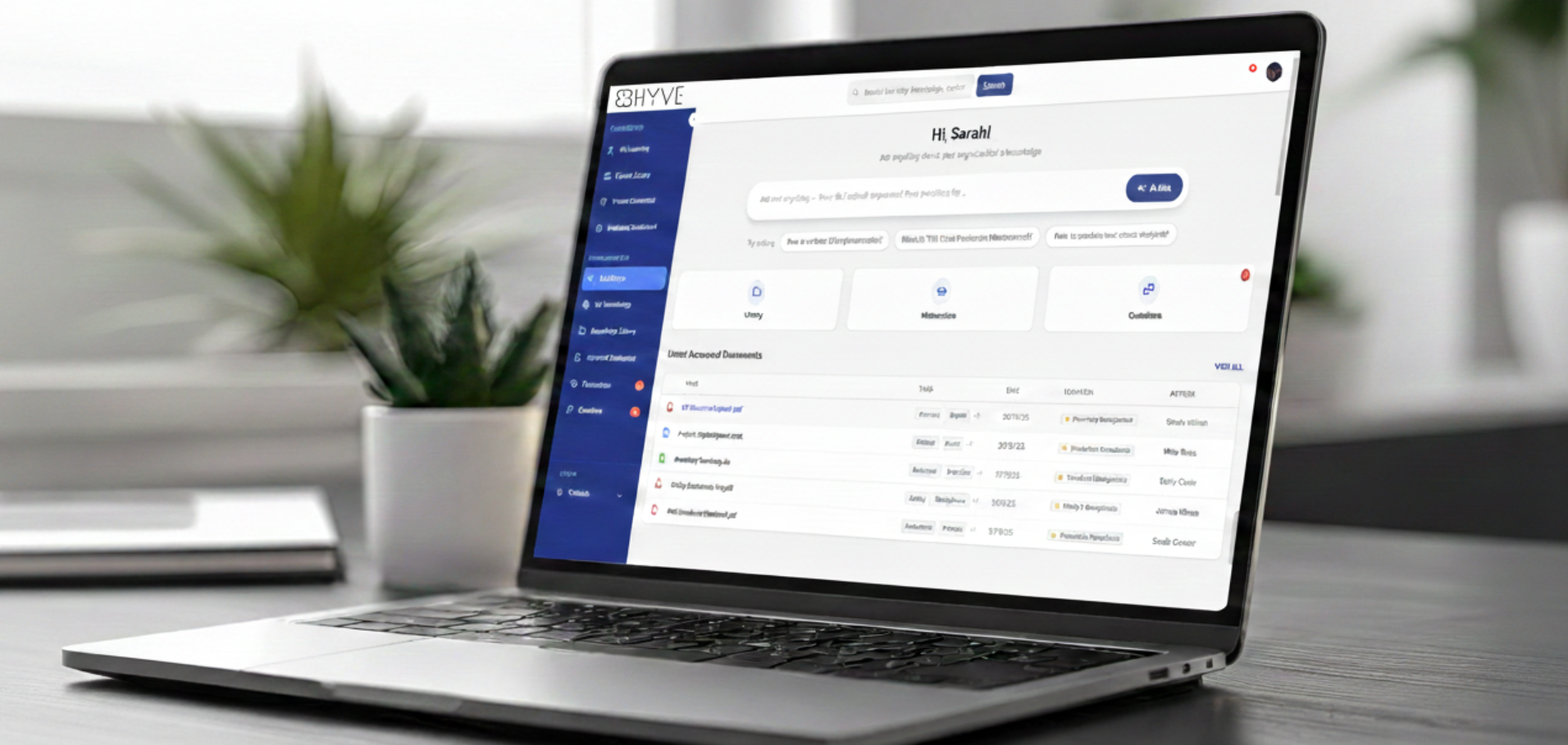
BHyve is an Indian Enterprise Knowledge Management vendor that works with some of the largest organisations in India - like Hindalco, GMR and Jindal. Built as a “Connected Digital Brain” of the business, BHyve offers enterprise-grade security and guardrails, can integrate with Microsoft, Google and Zoho. BHyve offers robust support for all forms of knowledge sharing like Text, Documents, Audio Video, Live Video and Live Q&A. Manufacturing, Audit & Tax, and Consulting firms today leverage BHyve AI for powerful search, summarisation, relatime calculations & assistants that can be embedded into other systems of work.
2. Confluence
Confluence is a knowledge management tool from the software giant Atlassian, and is primarily used by software engineering teams along with Jira. Confluence allows users to create pages, and provides excellent pathways for connecting code to software tickets to the knowledge base. Confluence works best
3. Notion
Notion is an American company that offers an all-in-one productivity and collaboration platform that combines note-taking, databases, task management, wikis, and project tracking into a customizable workspace. It's widely used for personal organization, team knowledge sharing, and enterprise workflows, especially with its AI features for content generation and automation
4. Microsoft SharePoint
SharePoint is Microsoft's cloud-based platform for building intranet sites, document libraries, and team collaboration spaces within Microsoft 365. It enables secure storage, organization, sharing, and access to files, lists, and workflows from any device. However, configuration requires time and can be an expensive affair.
5. Bloomfire
Bloomfire is an American EKM platform that helps teams overcome silos by enabling fast search, collaboration, and proactive insights. Bloomfire supports financial services and saas companies, and focuses on knowledge preservation and real-time collaboration.
Comparison Table - Enterprise Knowledge Management Systems (KMS)
Provider | Best For... | Key Strength |
BHyve | Large Enterprises, Manufacturing, Audit & Tax Firms, Consulting Firms | A "Connected Digital Brain" with robust AI guardrails and integration across Google, Microsoft, and Zoho. |
Confluence | Software Engineering | Deep integration with Jira; best for linking code to documentation. |
Notion | Startups & Creative Teams | Highly customizable workspace with intuitive generative AI features. |
SharePoint | Microsoft Ecosystems | Secure, cloud-based storage, though it often requires heavy configuration. |
Bloomfire | Financial Services & SaaS | Focuses on breaking down silos through fast, proactive insights. |
Enterprise AI Search: Provide Answers, Not Files
The biggest win for an Enterprise Knowledge Base in 2026 is not its ability to store and organise information, but to make it easily accessible to employees when they need it. Search is the most critical, and until now, the most overlooked experience of EKM. Employees are given folders to navigate, and they click 10 times before finding a document to scroll and find their information. Learn more about Enterprise AI Search - Read our article
The advent of AI changes that. Today, adding a powerful layer of AI means employees can ask questions to their knowledge management system in natural language, and AI brings them the right answers. Not files, but real, well-written, verifiable answers. The Enterprise Knowledge Base is built with the context of the organisation, so no external, unverifiable, or hallucinated information leaks in. Employees can post queries the way they do to managers, colleagues, and get help immediately.
Consider the old experience - An employee searches "Travel Policy," downloads a 40-page PDF, and scrolls to page 22 to find the daily allowance.
With Enterprise AI Search - An employee asks: "What is the daily meal allowance for a site visit in Mumbai?" The system replies: "It is ₹2,500 per day, as per the April 2025 policy update - with a link to cross-check."
This is a huge win for not just the employees looking for information, but the managers who constantly get disturbed for information. Managers, HR and IT colleagues & Team Leads are currently drowning in 117 emails and 153 messages daily. With Enterprise AI Search, AI effectively handles 50-70% queries, going into the relevant sources of information, putting together points, and presenting a final answer that's ready to use. It saves employees time, reduces their mistakes and rework, and ensures employees leverage the past knowledge of the business.
AI Knowledge Management: The Shift Every Enterprise Needs to Make in 2026
Enterprises today can’t sit out of the AI revolution. As work gets more complex and the speed of work increases, exploring AI Knowledge Management is an absolute must-do for organisations. Getting a safe, powerful, reliable, and user-friendly ensures employees are not bogged down with repetitive manual tasks.
Enterprises can no longer "wait and see" regarding AI. If you don't provide a secure AI Knowledge Management system, employees will go rogue; using public, insecure AI tools that risk leaking sensitive company data and bringing in unverified data as hallucinations. Both such scenarios have led to embarrassing outcomes for large organisations such as McDonald's, Deloitte, and AirCanada.
An AI Powered Knowledge Management Software today can resolve queries instantly, cut search time by 30-60%, and reclaim employee capacity for strategic work, giving a 15-30% productivity lift from structured KM to the business topline.
Enterprise Knowledge Management and Compliance
Enterprise knowledge management (EKM) is critical for compliance as it centralizes auditable repositories of regulations, policies, and lessons learned, enabling consistent adherence amid evolving rules like GDPR or HIPAA. Without it, scattered info leads to fines, errors, and audit failures. Poor Knowledge Management is said to cause 93% organisations to miss critical audit-readiness. A robust EKM offers a traceable record of trainings, deviations, changes in processes, updates to inspection protocols - all need in manufacturing for GMP readiness. It promotes collaboration across legal/risk teams, automates updates for regulatory changes, and cuts noncompliance risks like data privacy breaches via searchable repositories. In pharma/GMP, KM prevents batch failures and supports tech transfers, turning compliance into a proactive strength.
On the employees front, it ensures accessible, up-to-date training (e.g., via intranets like SharePoint), measuring completion to prove awareness. t fosters a "learning organization" culture, minimizing human errors in high-stakes sectors.
Frequently Asked Questions
Q: What is enterprise knowledge management?
A: Enterprise knowledge management is the process of capturing, organizing, and distributing an organisation's collective knowledge - including documents, expertise, processes, and training content - so employees can access accurate information quickly and make better decisions. This can include explicit knowledge - SOPs, checklists, diagrams, project reports, etc, but also tacit knowledge - insights, best practices, reflections, learnings. The formats can be text, images, video, live sessions, and even Q&A with experts.
Q: What is the best knowledge management software for large enterprises in 2026?
A: The best knowledge management software depends on your organisation's needs, industry, and existing tech stack. BHyve is the leading AI-powered option for enterprises seeking measurable productivity gains, compliance-ready governance, and a platform built specifically for enterprise-scale knowledge challenges. Confluence and SharePoint are strong choices for teams already invested in Atlassian or Microsoft ecosystems.
Q: What is AI knowledge management?
A: AI knowledge management is the use of artificial intelligence - including natural language processing, machine learning, and generative AI - to automate the capture, organisation, search, and delivery of enterprise knowledge. Rather than relying on keyword matching, AI knowledge management systems understand intent and context, delivering verified answers in seconds rather than requiring employees to dig through folders and files. AI can also understand intent and perform knowledge-related tasks - drafting 1-pagers, emails, comparing drafts,
Q: How does enterprise knowledge management support compliance?
A: A well-implemented EKM system creates documented, auditable records of processes, decisions, and policy acknowledgments. It ensures versioning so employees have access to the latest and most relevant information. It enforces access controls, supports retention schedules, and logs all interactions - making it far easier to demonstrate compliance during regulatory audits or investigations. A compliance-oriented EKM system delivers on accuracy, reliability, auditability, and security so enterprises can leverage the maximum value from it.
Q: What is the ROI of enterprise knowledge management?
A: According to industry research, effective knowledge management can reduce time lost searching for information by up to 35% and boost productivity by 20–25%. BHyve customers save an average of 30 minutes per employee per day - equivalent to 23 working days returned per employee per year - and cut repetitive internal queries by 50%.
Conclusion: Choosing the right EKM partner
Enterprise Knowledge Management has always been a critical part of a company’s compliance and productivity stack, and with AI bringing in real, measurable gains, bringing in an AI Knowledge Management System is one of the top checklist items of any organisation’s technology roadmap.
The right EKM partner doesn't just give you software; they give you a partnership. In the Indian context - where nuances of manufacturing, audit, and consulting are complex, you need a vendor that understands local scale and security needs. Don't let your organizational intelligence sit in a vacuum. Connect with BHyve today to see how our "Connected Digital Brain" can turn your company’s data into its greatest competitive advantage.